Before the First Lesson: How Backseat Years Quietly Shape Your Driving Instincts
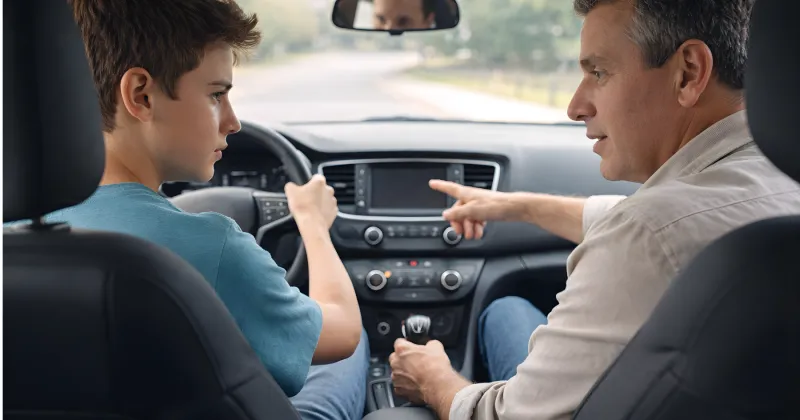
Photo: teenager driving lesson with instructor in car passenger seat, via kidsonblock.com
By the time most American teenagers sit behind the wheel for their first professional lesson, they are not blank slates. They are apprentices who never signed up for the apprenticeship. Years of riding in the passenger seat — watching Mom slow to a near-stop at that empty intersection, watching Dad steer with one wrist draped over the wheel — have already written a script in their heads about what driving looks like.
At Redin Motor School, our instructors see the results of this informal education every week. The habits are rarely dangerous in an obvious sense, but they are consistent, deeply rooted, and surprisingly visible to a trained examiner.
The Curriculum Nobody Wrote
Consider what a child absorbs from a decade of car rides. The rolling stop — a parent pausing for half a second at a quiet stop sign — teaches that stop signs are suggestions scaled to traffic. The one-handed turn, palm resting at the twelve o'clock position, signals that hand-over-hand steering is optional. The habit of checking mirrors only when changing lanes, rather than routinely, establishes a passive relationship with situational awareness.
None of this is taught explicitly. It is absorbed through repetition, and repetition is precisely what makes it durable. Psychologists who study motor learning note that behaviors rehearsed through observation can be as entrenched as those rehearsed physically. The student who insists they've "never driven before" has, in a meaningful sense, been rehearsing for years.
Why Instructors See It Immediately
An experienced instructor can usually identify a student's household driving culture within the first fifteen minutes. The tell is not any single error — it's the pattern. Students who trail one hand along the bottom of the wheel almost always learned it from a specific driver. Students who slow to a crawl but never fully stop at signs have almost always watched a parent do exactly the same thing.
Examiners notice these patterns too, though they score them differently. On a road test, a rolling stop is a deduction regardless of its origin story. A one-handed turn during a maneuver may read as a lack of vehicle control. The examiner does not care where the habit came from; the score sheet only records that it appeared.
Unlearning Is Harder Than Learning
The central challenge for students with strong passenger-seat inheritance is not acquiring new skills — it is interrupting old ones. Motor habits are overwritten, not deleted. This is why our instructors focus on replacement rather than correction. Telling a student to "stop rolling through stops" rarely works. Having them narrate every stop sign aloud — "signal, brake, full stop, scan" — does, because narration forces conscious processing into territory the habit had claimed as automatic.
The same principle applies to steering. Students who habitually palm the wheel benefit from structured hand-position drills in an empty parking lot, where the stakes are low and the repetition can be rebuilt from zero. Ten minutes of deliberate hand-over-hand practice in a controlled environment outperforms an hour of mixed driving where the old habit resurfaces under load.
A Practical De-Inheritance Plan
Students preparing for a road test can accelerate this process with a few deliberate steps:
- Audit the household. Ask whoever taught you to drive — or whoever you rode with most — what their habits are. Naming them out loud makes them easier to spot in yourself.
- Narrate during practice. Verbalizing each action interrupts automaticity and exposes habits you didn't know you had.
- Practice the boring fundamentals. Full stops, mirror checks, and two-handed steering feel remedial. They are also exactly where inherited shortcuts live.
- Simulate the test, not the commute. Practice routes and behaviors that mirror exam conditions, not the relaxed family-drive atmosphere in which your habits formed.
Turning Inheritance Into Advantage
There is a constructive side to all those passenger-seat hours. Students who grew up in the car often have strong road sense: they anticipate traffic flow, recognize hazards early, and feel comfortable in the driving environment. The task is not to erase that familiarity but to pair it with formal technique.
The students who pass most consistently are not those with the cleanest slate, but those who can distinguish between what they absorbed and what the examiner requires. Professional instruction exists precisely to make that distinction clear — and to replace a decade of borrowed habits with skills that are entirely your own.