What No One Tells You Before Your Road Test: The Unwritten Competencies Examiners Are Quietly Scoring

Every driver who prepares for a road test knows the official list. Parallel parking. Three-point turns. Proper signaling. Stopping at designated lines. These are the documented, teachable, scoreable elements of the driving examination, and most instruction is organized around mastering them.
What the official list does not capture — and what no curriculum explicitly teaches — is the second layer of evaluation that runs beneath the surface of every road test. Examiners are trained professionals. They are not simply watching whether you stop at the right place or signal before changing lanes. They are reading a much richer set of signals, most of which you have probably never been told to think about.
The following is a detailed breakdown of those unwritten competencies — the skills that experienced examiners evaluate without announcing them, and that prepared drivers demonstrate without necessarily knowing they are doing so.
1. The Physical Mechanics of Your Mirror Scan
Every driver knows they are supposed to check their mirrors. What fewer drivers understand is that how they check their mirrors is as visible and evaluable as whether they check them.
An examiner sitting in the passenger seat has a clear sightline to your head. They can see whether your eyes are genuinely moving to the mirror or whether you are performing a minimal head tilt that does not correspond to actual visual engagement. More importantly, they can see whether your head movement is consistent with the mirror you claim to be checking.
A proper rearview mirror check involves a brief, deliberate movement of the eyes — not the head — toward the mirror. A proper side mirror check involves a more visible head movement toward the respective side. A shoulder check for a lane change requires a genuine rotation of the head approximately 45 degrees toward the blind spot, not a barely perceptible glance.
Drivers who have learned to simulate mirror checks without actually performing them — a habit that develops when instructors accept the appearance of the behavior rather than verifying the substance — are often surprised to learn that examiners can identify the difference immediately.
2. Hand Placement Transitions During Maneuvers
The nine-and-three hand position (or, in some instructional frameworks, the eight-and-four position) is taught in every formal driving course. What is rarely taught is how to transition between hand positions during complex maneuvers in a way that communicates control rather than improvisation.
During a turn, particularly a sharper one, the steering wheel must be fed through the hands in a controlled, hand-over-hand or push-pull motion. The examiner is watching not only whether the turn is completed safely, but whether the driver's hands return naturally to the baseline position after the maneuver concludes. A driver who completes a left turn and ends up with their hands in an asymmetric, unrecovered position — one hand near the top of the wheel, the other somewhere in the middle — signals that the maneuver was reactive rather than controlled.
Smooth hand transitions communicate something important: that the driver has internalized vehicle control to the point where hand placement is managed automatically, not consciously negotiated in real time.
3. Speed Adjustment That Anticipates Rather Than Reacts
Every driver knows to slow down for a stop sign. The distinction that separates a competent driver from a novice one is when that deceleration begins.
Reactive braking — applying the brake when the stop sign is already visible at close range — is a signature of a driver who is processing the road in short segments. Anticipatory braking — beginning a gradual, smooth deceleration well in advance of a known stop — is the signature of a driver who is reading the road as a continuous sequence of conditions rather than a series of individual events.
Examiners are trained to distinguish between these two patterns. Progressive, early deceleration also produces a smoother ride for the passenger, which is itself a subtle but real signal of vehicle comfort and control. Candidates who brake smoothly and early communicate that they are seeing the road ahead, not just reacting to what is immediately in front of them.
4. Commentary Driving — Whether or Not You Are Asked
In some formal driver training contexts, particularly in professional licensing programs and advanced driving courses, candidates are asked to narrate their decision-making aloud. This practice, sometimes called commentary driving, is not universally required during standard road tests. However, the underlying competency it reveals — the ability to process and articulate the driving environment in real time — is something examiners can assess through other means.
Candidates who verbalize briefly and naturally during the test ("Checking my mirrors before the lane change" or "Slowing for the pedestrian at the crosswalk") do two things simultaneously: they demonstrate active situational awareness, and they give the examiner an unambiguous window into their decision-making process. This is not a requirement, and overdoing it can read as performative. But occasional, organic narration of significant decisions is noticed and, in most cases, viewed positively.
More broadly, the absence of any visible cognitive engagement — a driver who is silent, expressionless, and appears to be operating on autopilot — can create uncertainty for an examiner who is trying to assess whether the candidate is actively processing the environment or simply executing a memorized routine.
5. How You Handle the Unexpected
Every road test includes at least one unscripted moment: a pedestrian who steps toward the curb, a vehicle that pulls out from a side street, a cyclist who appears in the periphery. The examiner is not staging these events, but they are watching how you respond to them.
The evaluable behavior here is not the specific action taken — whether you braked or swerved or simply eased off the accelerator — but rather the quality of the response. A driver who reacts smoothly, proportionally, and without visible distress demonstrates that their attention is distributed across the full driving environment rather than concentrated narrowly on the task being evaluated.
A driver who is startled by a routine environmental event, or who overreacts in a way that creates secondary disruption, reveals that their situational awareness is narrower than it needs to be for safe independent operation.
6. Your Behavior Before the Vehicle Moves
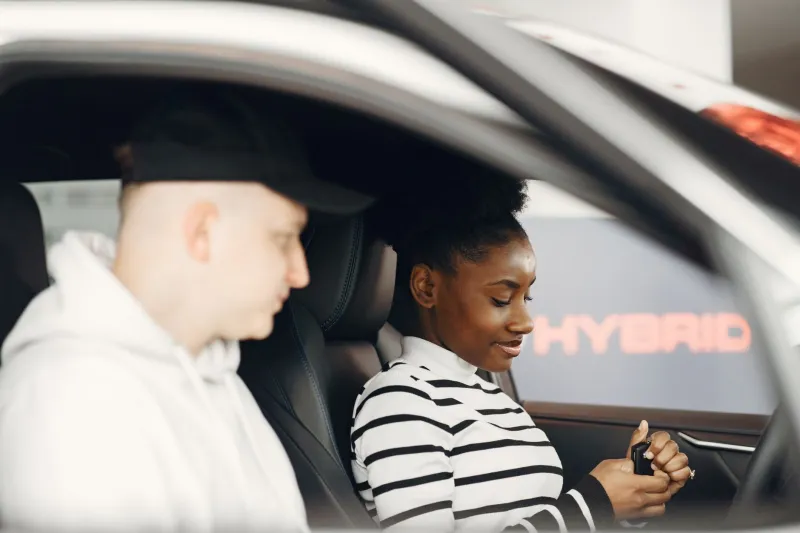
The evaluation begins before the car leaves the parking lot. Pre-drive behaviors — adjusting the seat, checking and adjusting mirrors, fastening the seatbelt, and taking a brief moment to orient before starting the engine — are observed by examiners as part of the overall readiness assessment.
This is not about performing a ritual for the examiner's benefit. It is about demonstrating that you have internalized the habit of preparing the vehicle before driving it. A driver who starts the engine and immediately moves without adjusting mirrors or confirming seat position is communicating, in a small but visible way, that pre-drive preparation is not yet an automatic part of their driving practice.
Bridging the Gap Between Training and Testing
None of the competencies described above are secret. They are the natural expression of thorough, internalized driver preparation. The reason they feel like hidden criteria is that most formal instruction focuses on the what of driving — the maneuvers, the rules, the procedures — without consistently addressing the how at the level of granular physical behavior.
At Redin Motor School, closing that gap is a central part of how we prepare drivers for licensing success. The road test is not simply a performance review of memorized skills. It is a holistic assessment of whether a driver has truly absorbed the discipline of safe, aware, and controlled vehicle operation. Preparing for it at that level is what separates drivers who pass with confidence from those who are surprised by their own score.