Wired to Be Distracted: How Modern Habits Are Quietly Undermining Your Road Test

There is a version of road test failure that is easy to diagnose: the candidate who runs a stop sign, misjudges a gap in traffic, or cannot complete a three-point turn. These are skill deficiencies, and they respond to practice. But there is a second category of failure — subtler, more pervasive, and increasingly common — that has less to do with driving ability and more to do with the state of a candidate's attention before they ever touch the ignition.
This is the distraction problem, and it is unlike anything driving instructors and examiners encountered even ten years ago.
The Attention Economy Has Reshaped the Default Brain State
To understand what is happening to today's road test candidates, it helps to understand what has happened to attention itself. The smartphone, and the ecosystem of applications designed around it, operates on a principle that neuroscientists and behavioral researchers have documented extensively: variable reward schedules produce compulsive checking behavior. Every notification, every scroll, every brief engagement with a social feed reinforces a neurological pattern of fragmented, interrupt-driven attention.
The average American now checks their phone well over 100 times per day, according to behavioral research aggregated by multiple academic institutions. For younger drivers — the demographic most likely to be sitting for a first road test — that number is often higher. The consequence is not merely that people are distracted when they are actively using their phones. It is that the habitual pattern of fragmented attention begins to shape the brain's default operating mode. Sustained, singular focus becomes effortful. Environmental scanning — looking ahead, checking mirrors, monitoring peripheral movement — competes with an internalized expectation of interruption.
This is the neurological profile that many candidates bring to their road test, often without realizing it.
How Examiners Detect Distraction-Prone Behavior
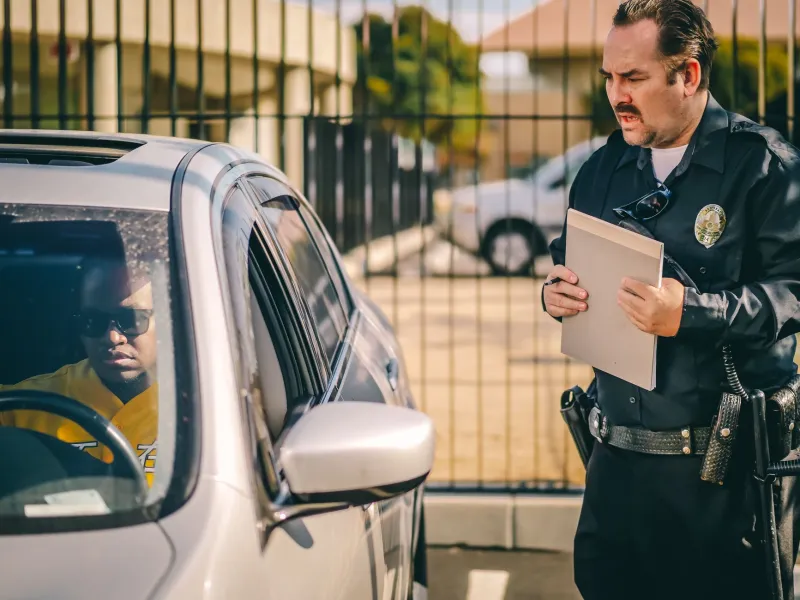
Experienced road test examiners do not need to see a candidate reach for a phone to identify distraction-prone behavior. The behavioral signatures are visible in driving patterns that would otherwise seem unrelated to device use.
Delayed responses at intersections. A candidate who pauses fractionally longer than expected before proceeding at a green light, or who creeps into an intersection before fully scanning for cross traffic, may simply be in the habit of mentally switching between tasks. The pause that looks like hesitation is often the cognitive equivalent of a lag between notifications.
Inconsistent speed management. Drivers who are accustomed to divided attention often have difficulty maintaining a consistent speed on open roadways. Their speed drifts upward or downward in small increments, reflecting attention that is partially elsewhere — even when the phone is not present. The habit of distraction persists even in its absence.
Mirror usage that is mechanical rather than purposeful. Candidates sometimes learn to check mirrors on a schedule — every five to eight seconds, as instructors recommend — without actually processing what they see. Examiners can often distinguish between a driver who is genuinely monitoring their environment and one who is performing the gesture of monitoring. The difference shows in how the driver responds to what they observe.
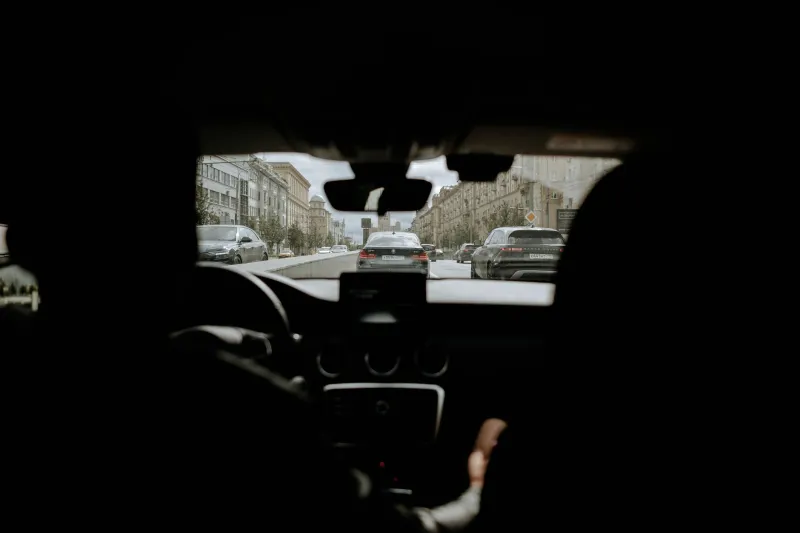
Passenger-triggered attention shifts. For candidates who routinely drive with peers or family members present, the social conditioning around conversation in a vehicle can be deeply ingrained. Even a silent examiner sitting beside them can trigger an internalized social attention pull — a subtle orientation toward the passenger rather than the road ahead.
The Passenger Problem
It is worth addressing the passenger variable specifically, because it operates differently from phone-based distraction and is often underestimated by candidates.
Driving with friends or family members is, for most new drivers, the primary context in which they accumulate their supervised hours. This creates an associative link between driving and social engagement that can be genuinely difficult to override. Candidates who have spent months driving with a parent offering real-time commentary, or with friends in the back seat, have been training their attention to share bandwidth with social input.
The examiner's presence activates this same social channel — but with none of the familiar conversational content to fill it. The result is often a candidate who is simultaneously trying to drive, manage the social discomfort of silence, and suppress the impulse to speak or look toward the person beside them. That triple cognitive load is not trivial, and it shows up in the quality of driving decisions made during the test.
Deprogramming for the Test: Practical Resets
The encouraging reality is that attention habits, while powerful, are not immutable. Deliberate practice can recondition the brain's default mode toward sustained focus — particularly when that practice begins several weeks before the road test rather than the night before.
Implement phone-free driving as a non-negotiable rule. This may seem obvious, but the goal here is not compliance — it is reconditioning. Every supervised practice session should occur with the phone in the back seat or the glove compartment, powered down or silenced. Over time, the absence of the device in the front seat should begin to feel normal rather than restrictive.
Practice with a silent observer. Ask your supervising driver to ride without speaking for entire sessions. The discomfort this initially produces is the point — it surfaces the social attention pull in a low-stakes context where you can work through it. Over several sessions, the silence will begin to feel unremarkable, which is exactly how you want the examiner's presence to feel.
Develop a pre-drive ritual. Athletes use pre-performance routines to shift mental states deliberately. Drivers can do the same. Before each practice session, spend 60 seconds with the vehicle stationary: adjust your mirrors with intention, place your hands on the wheel, look ahead, and consciously set the intention to focus only on what is happening in and around the vehicle. This is not a mystical practice — it is a behavioral cue that signals a transition from the fragmented attention state of daily life to the focused state that driving requires.
Audit your passenger habits. If you consistently drive with the radio at high volume, with passengers talking, or with your phone visible on the dashboard, you are training yourself to drive amid distractions. In the weeks before your test, progressively reduce these inputs. Drive in silence. Limit passengers to one at a time. Create the conditions that most closely approximate what the test environment will feel like.
A Candid Assessment
It would be convenient to frame distraction as a character flaw — a matter of discipline that candidates simply need to exercise more rigorously. That framing is both inaccurate and counterproductive. The attention patterns that undermine road test performance are the product of an environment specifically engineered to fragment focus, and most candidates have been immersed in that environment for years.
Acknowledging this honestly is not an excuse — it is a prerequisite for effective preparation. Candidates who understand that their attention has been shaped by their environment can take deliberate steps to reshape it. Those who do not recognize the problem cannot address it.
At Redin Motor School, we believe that licensing preparation must account for the full profile of the modern driver — not just their technical skill set, but the attentional habits they carry into the vehicle. Passing a road test today requires more than knowing how to drive. It requires the ability to be fully present while doing so. In an era defined by constant connectivity, that capacity must be actively cultivated, not assumed.