Coaching From the Passenger Seat: A Phrasebook for Parents Who Practice With Their Teen Driver

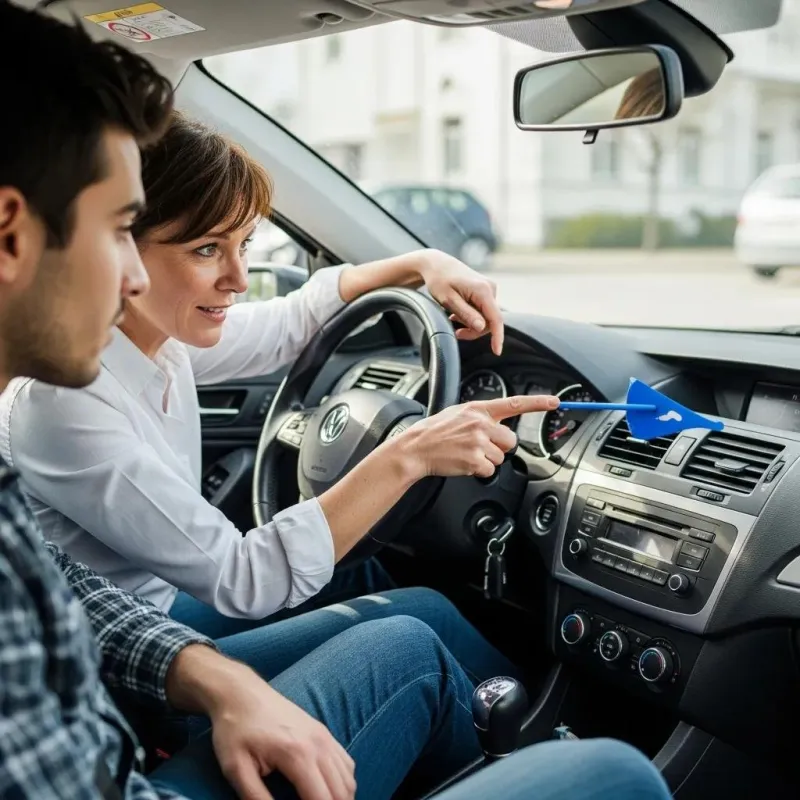
Photo: parent supervising teen driver practice calm conversation in car passenger seat, via www.readswrites.com
Every supervised driving hour has two instructors: the professional in the front passenger seat during lessons, and the parent beside the learner on the other days of the week. The second one is rarely trained, frequently tired, and usually invested in a way no instructor can be. That combination produces some of the least helpful coaching in the entire learning process — not because parents care too little, but because they care at close range and in real time.
This guide is built around one principle: the parent's job is not to teach driving from scratch. It is to protect and repeat what the instructor has already taught.
Why the Passenger Seat Is the Hardest Teaching Job in the Family
A classroom teacher can pause. A coach on a practice field can call a timeout. A parent supervising a sixteen-year-old on a four-lane arterial has no pause button, no rewind, and a genuine stake in the outcome. Fear arrives before language does, and what comes out of the mouth is often a gasp, a grab at the door handle, or a shouted instruction delivered three seconds too late.
None of that is a character flaw. It is a predictable response to a stressful environment. But it does affect the learner, and it does affect the driving.
Three Rules That Prevent Most Conflict
Direct before the moment, not during it. Most useful coaching happens before the driver reaches the intersection, not in the middle of the turn. Say which lane you want, which exit you are taking, or where you would like the next stop, several seconds in advance.
One voice at a time. If a professional instructor's method differs from yours, the car is the wrong place to resolve it. Defer in the moment and raise the question afterward — with the instructor, ideally.
Correct in the past tense. Anything said while the wheel is moving should be navigational. Anything evaluative belongs after the gear selector is in park.
What to Say After a Mistake
A learner who has just made an error already knows. The productive question is what they noticed, not what you noticed.
- Pull over when it is safe, and let us walk through that turn.
- Take a breath. What did you see just before you started to move?
- That was a wide right. Where were your eyes when you began the turn?
- Good recovery. Let us try it again at the next light.
- I am going to be quiet for the next five minutes. Drive the way you would with your instructor watching.
The pattern here is consistent: a pause, a question, a second attempt. Praise the correction rather than the absence of error, because the correction is the actual skill.
What to Bite Back Mid-Drive
Some sentences feel helpful and land as damage. These are the ones to swallow.
- Watch out. Two words with no destination, delivered at volume, producing panic rather than action. Name the hazard instead: Bicyclist on the right.
- Grabbing the wheel or the door handle. A learner reads both as evidence that you do not trust them, and often responds by freezing rather than correcting.
- Contradicting the instructor. Hand position, mirror timing, and braking method should come from one source. If you disagree, take it up with the instructor later.
- Re-litigating a mistake from ten minutes ago. A correction has a shelf life of roughly thirty seconds. After that it becomes a mood.
- Commentary on other drivers. Cursing the driver ahead teaches a learner that the road is a stage for grievance.
- Any sentence that begins with when I learned. Your habits are not the curriculum, and some of them predate modern guidance.
The Debrief: Ten Minutes After the Car Is Parked
Parked, transmission in park, engine off. Now there is time for evaluation, and a short structure keeps it from becoming a lecture.
- Ask first. What went well today? Let the learner identify two things before you offer any.
- Name one thing to keep. Be specific: Your following distance on the highway was excellent.
- Name one thing to change. One item only. A list of five corrections becomes background noise.
- Agree on next time. Next session, we will work on left turns at unprotected intersections.
- Send a note to the instructor. A text with one sentence about what you practiced and where the learner struggled is more valuable than most parents realize.
Ten minutes, once, after the car is off. Not twenty minutes replayed at dinner.
Keeping One Voice With the Professional Instructor
Ask the instructor, at the start of the course, what they are working on this month. Ask what vocabulary they use — do they say cover the brake or hover? Do they teach shuffle steering or hand-over-hand? Consistency of language matters more than either family's preference, because a learner hearing two sets of terms has to translate before they can act.
Many schools encourage a brief check-in after each block of lessons. Use it. A parent who knows the current lesson objective can reinforce it in fifteen-minute drives without inventing a curriculum of their own.
When to Stop Talking Altogether
Some conditions make coaching unproductive regardless of phrasing: the first few night drives, a learner who is visibly fatigued, heavy traffic on an unfamiliar freeway, or a session that follows an argument. In those situations, silence is a legitimate teaching tool. Sit still, watch the road, and let the drive be the lesson.
Supervised practice requirements vary by state, and the number of hours is a floor rather than a goal. Two short, calm drives a week will build more competence than one long, tense outing — and far more than a single drive that ends with both passengers not speaking.
A Simple Weekly Rhythm
Pick two days. Choose a route that is mostly familiar with one new element. Name a single focus for the session and hold to it. Debrief for ten minutes after parking. Then close the topic until the next scheduled drive.
Consistency of that kind is what transforms a nervous passenger into an effective second instructor — and it is what keeps a learner's confidence intact between professional lessons.