Stillness Under Pressure: Why the Best Drivers Wait Without Moving
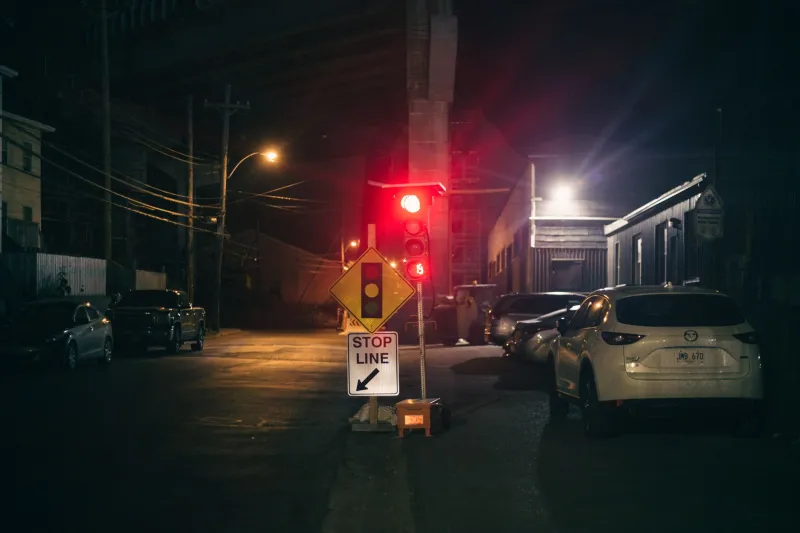
Watch a novice driver at a red light and you will often observe a subtle but telling behavior: the vehicle inches forward. Not dramatically — perhaps just a few inches, perhaps half a car length over the course of a thirty-second wait. The driver may not even be aware they are doing it. But the examiner sitting beside them almost certainly is.
This behavior — sometimes called "creeping" in professional driver evaluation circles — is one of the more nuanced indicators of a candidate's psychological relationship with their vehicle. It is also one of the most misunderstood. Many new drivers believe that easing forward at intersections or positioning early into turning lanes communicates readiness and attentiveness. In reality, it communicates something quite different.
What Creeping Actually Signals
The act of inching a vehicle forward while waiting at a red light or stop sign is, at its core, a response to discomfort with stillness. The driver wants to be moving — or at least to be closer to moving — because the waiting feels passive and unproductive. Applying slight pressure to the accelerator, even unconsciously, is a way of managing that discomfort.
Examiners recognize this pattern because it appears consistently among drivers who are anxious, underprepared, or lacking confidence in their ability to respond quickly when the signal changes. The logic the driver is following — "I'll be closer to the intersection when the light turns green" — is a rationalization of an impulse-driven behavior rather than a deliberate strategic choice.
The distinction matters because competent driving is, by definition, deliberate. Examiners are not scoring reactions. They are scoring decisions.
The Difference Between Strategic Positioning and Nervous Habit
Not all forward movement while waiting is problematic. There are circumstances in which repositioning your vehicle before a signal changes is entirely appropriate and even expected.
Correcting an improper stop position — if you have stopped too far back from a crosswalk or stop line and need to advance to a point where the intersection is visible — is a legitimate, examiner-approved adjustment. The key is that it is a single, purposeful movement to a specific position, followed by a complete stop.
Pulling forward to clear a crosswalk after yielding to pedestrians, or advancing to improve visibility around a large vehicle, are similarly defensible actions when they are executed deliberately and terminated with a firm stop.
What distinguishes these from problematic creeping is the presence of a clear rationale and the absence of continuous, incremental movement. A strategic repositioning has a beginning and an end. Nervous creeping has only a beginning — it continues, in small increments, until the driver is finally permitted to accelerate.
The Early Turn Lane Problem
A related behavior involves candidates who drift into turning lanes or merge lanes significantly earlier than the road situation requires. The reasoning is similar: getting into position early feels like preparation. It feels like the driver is ahead of the situation rather than reacting to it.
However, examiners evaluate lane changes and lane positioning based on both legality and appropriateness. Moving into a right-turn-only lane three blocks before the intersection — when traffic conditions do not require it and no sign designates that section of lane — can create confusion for other drivers and suggests the candidate is managing anxiety through early action rather than navigating the road with measured judgment.
The confident driver enters the appropriate lane at the appropriate time. Not early. Not late. At the moment the road geometry and traffic conditions indicate it is correct to do so.
Impulse Control as a Driving Competency
What examiners are really assessing when they observe creeping behavior is impulse control — the capacity to remain still, alert, and ready without converting that readiness into premature action. This is a genuine competency, and it is one that correlates strongly with overall driving quality.
Drivers with strong impulse control hold their position at a stop, maintain consistent lane discipline, and execute maneuvers when they are actually warranted rather than when they feel overdue. They are comfortable with the gap between intention and action. Drivers with weaker impulse control tend to move before conditions are fully ready, change lanes with insufficient cause, and — yes — inch forward at red lights.
This is not a character judgment. Impulse control in driving, as in many other domains, is a trainable skill. But it requires deliberate attention during the practice phase, not just awareness during the test itself.
How to Train Stillness
Developing the capacity to wait comfortably without moving requires practice that most driving curricula do not explicitly address. Here are the specific habits worth building during your supervised driving hours:
At every red light, make a conscious decision to hold your foot on the brake and maintain your position until the signal changes. Notice the impulse to inch forward and choose not to act on it. Over time, this becomes the default response.
At stop signs, come to a complete, full stop — not a rolling deceleration that transitions into movement. Hold for a full count before proceeding. This trains the physical habit of genuine stopping and eliminates the gradual-roll pattern that examiners identify as an incomplete stop.
During lane-change preparation, identify the correct entry point for the destination lane before you begin moving. Execute the change at that point — not before it — and avoid the habit of "pre-positioning" by drifting toward the lane line in advance.
At Redin Motor School, we incorporate what we call "stillness drills" into our advanced pre-test preparation sessions. These are not complicated exercises — they simply involve practicing the discipline of staying stopped when stopped, and moving only when movement is genuinely appropriate. The results, in terms of road test performance, are consistently meaningful.
Confidence Looks Like Calm
There is a broader principle at work here that is worth naming directly. On a road test, confidence does not look like eagerness. It does not look like constant motion or visible preparation. It looks like calm — the calm of a driver who knows exactly what they are doing, who is not threatened by a red light, and who has no need to inch their way toward readiness because they are already ready.
Stillness under pressure is not passivity. It is control. And control, demonstrated consistently throughout a road test, is precisely what earns a passing score.