Quiet Cars, Loud Habits: What Electric Vehicle Instruction Must Teach in 2026

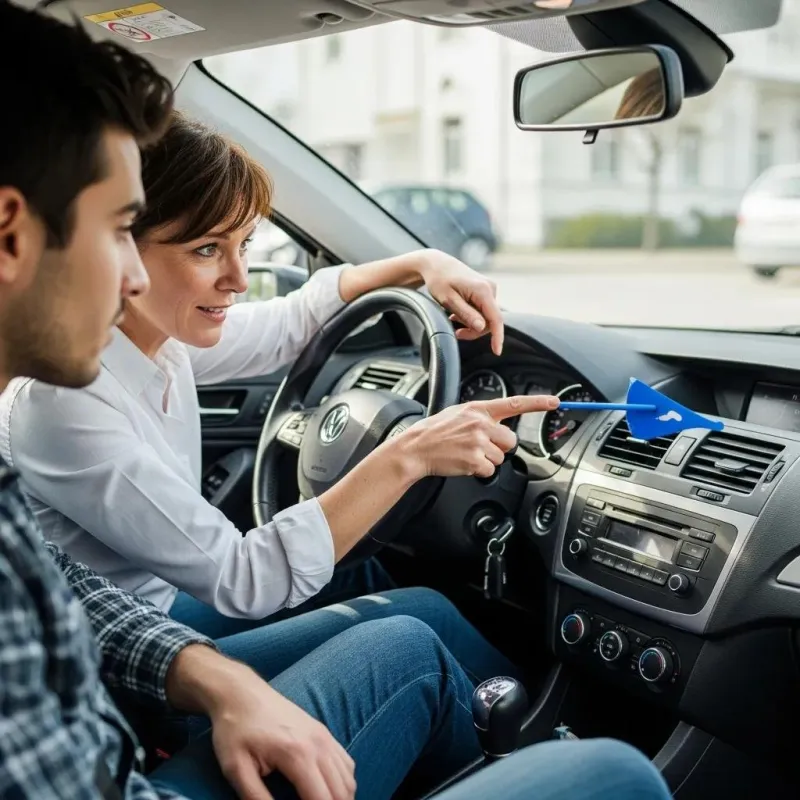
Photo: driving instructor teaching student in electric car dashboard charging, via motorcarcentral.com
A learner in an electric vehicle pulls away from a curb in near silence, and the instructor beside them hears nothing. No rev, no shift, no idle. That absence is not a minor detail of the learning experience. It is the central fact of it.
Electric vehicles are now common enough that a meaningful share of American learners will take their first lessons in one, whether it belongs to a parent, a school, or a car-share. Most will also sit for a road test in a conventional gasoline vehicle, because that is what many testing agencies and driving schools supply. Teaching well in 2026 means preparing students for both, without pretending the two experiences are interchangeable.
The Cues That Quietly Disappear
Generations of instruction leaned on sounds and sensations that an electric drivetrain does not produce. The engine note told a learner roughly how fast the car was moving. Idle creep pulled the vehicle forward at a stop and taught foot control almost by accident. Vibration through the floor and wheel gave feedback about road surface and load.
None of these are strictly necessary. All of them were free. Remove them and the instructor must supply deliberately what the gasoline car supplied automatically.
Instant Torque and the Switch-Not-Dial Problem
Electric motors deliver pulling force the instant the pedal moves. That makes an electric car feel eager, and it rewards a smooth, progressive foot. It also punishes the habit many new drivers bring from elsewhere: treating the accelerator as a switch, either pressed or released.
In a gasoline car, a clumsy pedal input is softened by the drivetrain. In an electric car, the same input produces an immediate lurch. Learners who spend their first ten hours in an electric vehicle often develop a remarkably delicate foot — a genuine advantage. Learners who are never corrected develop a jumpy one, and that habit reads as poor vehicle control to any examiner.
One-Pedal Driving: A Real Skill and a Fragile Reflex
Regenerative braking slows the car substantially when the driver lifts off the accelerator. Many electric owners drive this way almost exclusively, and for good reason: it is efficient, smooth, and easy to maintain in traffic.
It is also a habit that can fail a learner in a different car. A student trained on one-pedal driving may enter an intersection with the right foot resting on the accelerator and no preparation on the brake. In the electric vehicle, lifting off would have slowed the car. In the gasoline vehicle, lifting off does very little, and the car keeps rolling toward the crosswalk at exactly the wrong moment.
The remedy is not to forbid regenerative braking but to teach it as a mode rather than a method. Students should practice driving with regeneration reduced or disabled so that the brake pedal remains their primary tool for managing speed.
Braking Without the Familiar Fade
Electric and hybrid vehicles blend regenerative and friction braking, which can make the pedal feel inconsistent: firm at one moment, soft at another. New drivers interpret that inconsistency as their own error and begin braking earlier and harder than necessary. Instructors should demonstrate the blend, then run repeated firm stops from low speed so the student learns that the pedal can always be trusted at the bottom of its travel.
Hearing What the Car Cannot Announce
At parking-lot speeds, pedestrians navigate partly by sound, and an electric car gives them very little. Federal rules require an audible alert at low speed, but a generated tone is not a substitute for the driver's own attention. Learners should be taught to scan parking lots, crosswalks, school zones, and bike lanes more actively than they would in a louder car, and to treat every backing maneuver as a blind spot exercise.
Speed Without a Soundtrack
Quiet cabins make speed feel lower than it is. A student traveling forty miles per hour in a well-insulated electric car may feel as though they are doing thirty. The fix is mechanical: a deliberate glance at the speedometer every eight to ten seconds, and a spoken habit in early lessons where the student says the current limit aloud as they approach a new zone.
For Adults Who Will Test in a Gasoline Vehicle
Adults who buy or lease an electric car and then schedule a test in a conventional one face a specific transition. A short, structured plan covers it.
- Spend at least three lessons in the test vehicle, not merely one.
- Practice idle creep in a quiet parking lot to relearn foot control at a stop.
- Run emergency stop drills, since regenerative braking alone will not produce the required deceleration.
- Reintroduce engine noise as information, pointing out what the sound is telling the driver.
- Practice hill starts and slow-speed maneuvering, where the differences are most noticeable.
Designing Electric Vehicle Lessons in 2026
A well-structured electric-vehicle curriculum looks much like a gasoline one, with three additions: narration of speed, deliberate brake-pedal drills, and periodic driving with regeneration switched off. Instructors should also verify at booking which vehicle the student will use for the road test, so the final week can be planned around it rather than improvised on the morning of the appointment.
What Parents Should Reinforce at Home
The temptation with a quiet, smooth family car is to let the vehicle do the teaching. It will not. Parents supervising practice should require brake-pedal use in the final stretch of every stop, insist on a speed check before every new road segment, and — if the test will be taken in a gasoline car — arrange for the student to drive one well before the appointment.
The quiet is not a defect to be overcome. It is a different set of conditions, and different conditions require instruction that is explicit about what the driver can no longer take for granted.