Which Car Should You Practice In? Matching Your Training Vehicle to Your Test Vehicle

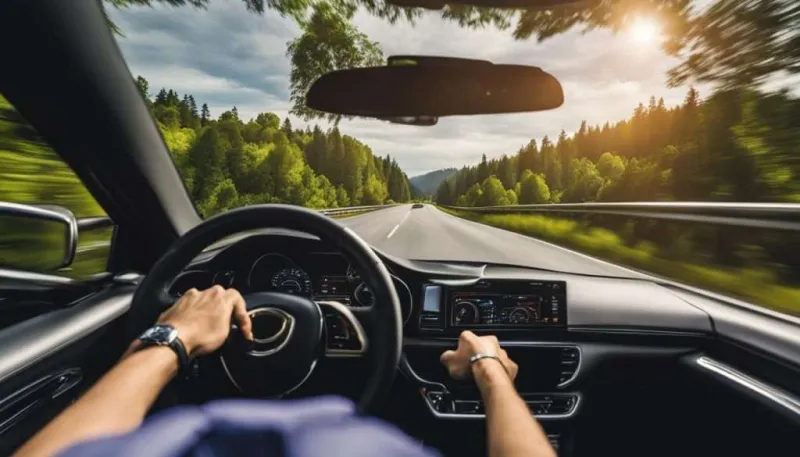
Photo: teen driver adjusting seat and mirrors in unfamiliar car before driving lesson, via as2.ftcdn.net
Few learners sit for their road test in the same vehicle they learned in. A teenager practices for months in a parent's aging sedan, then borrows an aunt's crossover on exam day. An adult student trains in a driving school's compact, then arrives in a recently purchased SUV with a higher seating position and pedals that sit several inches off the floor. On paper, nothing has changed. Behind the wheel, almost everything has.
The distance between being able to drive and being able to drive this particular car is narrower than most families expect, but it is real, and it tends to announce itself at the worst possible moment: during the first ten minutes of a road test, while an examiner is still forming an impression.
Why an Unfamiliar Vehicle Feels Like Starting Over
Driving competence is partly general and partly local. The general part — scanning traffic, holding a following distance, reading an intersection, selecting a speed that fits conditions — belongs to the driver and travels with them. The local part belongs to the car: where the front bumper actually ends, how far the seat must slide to reach the pedals, how much pressure produces a smooth stop, which pillar blocks the view at a four-way stop.
Veteran drivers automated those local calibrations years ago, which is why a rental car feels odd for five minutes and then feels normal. A learner has not automated them. Every adjustment is still a conscious decision, and a new vehicle multiplies the decisions, drawing attention away from traffic. The result is not a loss of skill but a loss of bandwidth — and examiners read that strain as uncertainty.
Four Adjustments That Cause Most of the Trouble
Mirror geometry. Two cars of the same size can present entirely different views. A learner who has learned to judge the right curb from one mirror will misjudge it from another until the new reference point is established deliberately.
Seat and pedal relationship. A seat pushed back for comfort shortens the stroke available on the brake. In an unfamiliar car, students often sit too far from the pedals because the dashboard looks closer than it is.
Throttle and brake response. Some vehicles lurch from a light touch; others feel numb for the first inch of travel. Testing the brakes at low speed in an empty lot costs three minutes and prevents a jerky first stop at a stop sign.
Sightlines and blind spots. Hood length, windshield rake, and pillar width vary enough to change how a driver judges a turn into a narrow lane. A driver who has internalized one car's proportions will clip a curb in another.
What Transfers and What Does Not
Skills that travel cleanly between vehicles include lane-position judgment, mirror-scan rhythm, signal timing, gap selection at intersections, hazard anticipation, and speed selection relative to weather and traffic. These are driver skills, not car skills, and a good instructor builds them to be portable.
Skills that must be rebuilt in each vehicle include pedal pressure, mirror reference points, turning radius, steering weight, hood length, and the feel of the brake at the very end of a stop. Families routinely assume this second list is trivial. It is trivial to someone with ten years of experience and anything but trivial to someone with forty hours behind the wheel.
A Checklist for the First Drive in an Unfamiliar Car
- Adjust the seat first, then the mirrors. Reversing that order guarantees a second round of adjustments before you leave the driveway.
- With your back against the seatback, confirm you can press the brake fully to the floor without locking your knee.
- Locate the headlights, wipers, hazard lights, and defroster before moving. Examiners ask for these by name.
- In an empty parking lot, make three or four low-speed stops to learn where the brake engages.
- Practice one right turn and one left turn at a familiar intersection to recalibrate your sense of the vehicle's corners.
- Check each blind spot while parked, turning your head rather than trusting the mirror alone.
- Confirm the fuel or charge level, and verify the vehicle will satisfy the testing agency's requirements on the day.
Choosing a Practice Vehicle: Advice for Families
Consistency beats prestige. A modest car driven for fifty hours produces a more dependable test-day performance than a luxurious one driven for ten. Where a family has a choice, the vehicle used for the bulk of practice should be the vehicle used for the exam, provided state rules allow it.
If that is impossible — because the test will be taken in a school car, or the family vehicle is unavailable on the scheduled date — rotate deliberately rather than suddenly. Introduce the second car at least two weeks before the test and give it a full lesson, not a five-minute errand. A last-minute substitution teaches a learner that cars are interchangeable. A planned rotation teaches the opposite: that every vehicle requires a short, methodical reorientation.
Before the appointment, check the licensing agency's vehicle requirements. Jurisdictions vary on acceptable vehicle types, required equipment such as a functioning horn and parking brake, and whether rentals may be used without written permission from the owner.
How Instructors Can Engineer the Transfer
A professional instructor can convert a vehicle change from a threat into a lesson. The most useful step is also the simplest: ask, at the time of booking, which vehicle the student will use on test day. If the answer is not the training car, schedule a dedicated orientation session in the final week.
That session should make reference points explicit. Have the student pull up to a stop line, step out, and see where the bumper actually sits. Repeat the exercise for parallel parking and for the right curb. Reference points learned by eye, rather than by feel alone, survive the move to a different car.
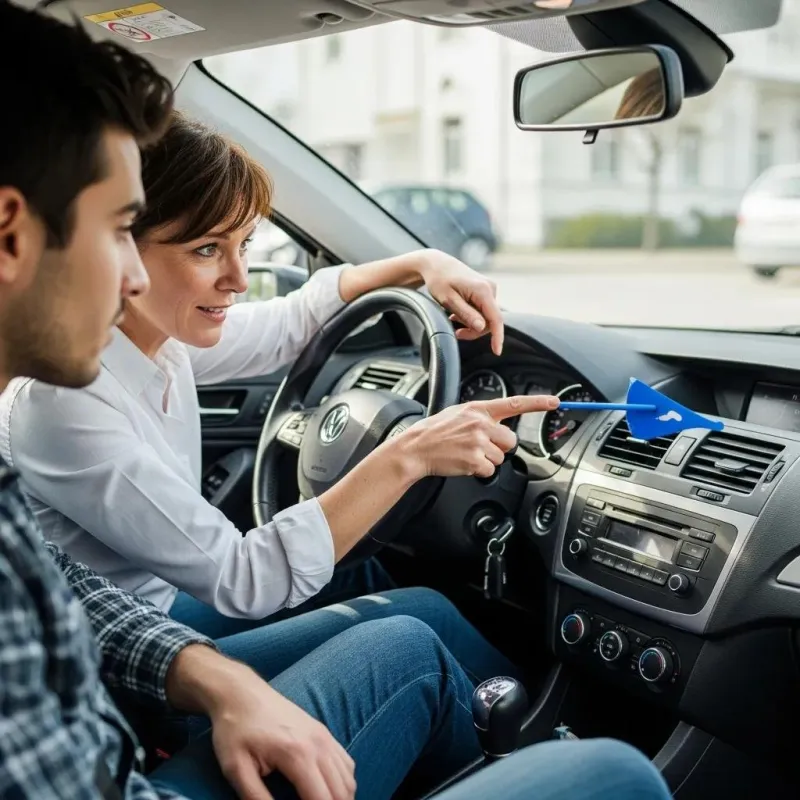
Instructors can also prepare parents with a brief conversation about seat position, mirror setup, and the difference between a firm stop and a grabby one. That short exchange prevents the most common home-practice error: a seat adjusted for the passenger's comfort rather than the driver's control.
The Final Week
In the seven days before a test, drive the exam vehicle twice — once in light traffic, once in conditions resembling what the test is likely to include. Confirm registration, insurance, and inspection. Fill the tank or charge the battery. Clear the cabin of anything that could roll beneath the brake pedal.
Confidence on test day is rarely a matter of bravado. It is the accumulated certainty that the machine beneath you will do what you ask. That certainty is built deliberately, one vehicle at a time.